

From Commons to Commodities and Back: A Regenerative Commons Manifesto
Samuel Delesque
December 27, 2025
For centuries, Western techno-civilization has treated land and nature as objects apart – resources to extract, commodities to trade. This worldview built dazzling cities and innovations, yet it also left scars: forests felled, soils exhausted, species extinguished. Now, in an era of climate crisis and mass extinction, humanity is being forced to reconsider its relationship with nature. A new paradigm is emerging, one that marries ecological wisdom with human inventiveness, aiming to cultivate a future where we thrive because of nature, not in spite of it[1]. This manifesto-meets-thesis is a call to action and an intellectual journey, framed in the personal voice of a steward as much as a founder. It charts the path from an extractive past toward a regenerative future of commons-based stewardship. It is at once a philosophical reflection, an academic exploration, and a visionary outline of the work we undertake at OASA – an emergent protocol for land in commons.
From Commons to Commodities: A Brief History of Land and Ownership
The story of land over the last 300 years is a story of enclosure and commodification. Before the industrial era, many landscapes were governed as commons – shared pastures, forests, and waters where local communities managed resources collectively under customary rights. The rise of colonialism and industrial capitalism upended this balance. As scholar-activist Vandana Shiva recounts, "Land and forests were the first resources to be 'enclosed' and converted from commons to commodities."[2] Enclosure acts in Europe, particularly 18th-century England, privatized common land, displacing subsistence farmers and concentrating land ownership. This process spread globally through empire: forests that indigenous peoples once treated as sacred commons were seized as state property or concessions for timber and cash crops[3]. The destruction of the commons was not an accident but a prerequisite for the industrial revolution's rapacious appetite for raw materials. "A life-support system can be shared, it cannot be owned as private property," Shiva notes – thus commons had to be privatized to feed the engines of industrial progress and capital accumulation[4]. What was once held in communal trust became real estate, plantation, mine. By the mid-20th century, nearly the entire terrestrial surface had been claimed under some form of exclusive tenure, erasing or eroding the communal land management systems that had endured for millennia.
The consequences of this commodification of land were profound. Traditional commons regimes were often imperfect, but they embodied a balance of rights and responsibilities among users – a sense that land is a "bundle of relationships rather than a bundle of rights", with community obligations to sustain it[5]. Enclosure severed those relationships. It imposed a reductionist view of land as capital and people as tenants or trespassers. In many parts of the world, indigenous communities who had co-evolved with their landscapes were forcibly displaced or had their stewardship roles criminalized. Colonial laws (such as the Indian Forest Act of 1865) reserved forests for state control and commercial extraction, stripping local people of their ancestral rights[6]. What appeared to European eyes as "wilderness" was often a landscape actively managed for abundance and diversity by its original inhabitants[7]. Europeans misread these lands as unused, thus justifying their enclosure; in truth, people were acting as a keystone species, shaping ecosystems through millennia of care – from the burning practices of Aboriginal Australians that fostered mosaic grasslands, to the orchards and hunting rotations of Native American nations[7][8]. The Enclosure of the commons did not just conquer lands; it attempted to erase this co-evolutionary role of humans in nature.
The Cost of Extraction: Ecological and Social Collapse
Three centuries of treating land as a commodity have led us to a planetary precipice. By disconnecting ownership from stewardship, the extractive model has undermined the very ecological foundations on which it depends. Biodiversity loss has reached cataclysmic levels. A landmark global assessment warns that up to 1 million species are now threatened with extinction within decades due to human activities[9]. Biodiversity – the intricate web of life – is declining faster than at any time in human history[10]. Habitat destruction, driven by land-use change (agriculture, logging, urban expansion), is a primary culprit. We are literally cutting off the limbs of the living planet, and with each lost ecosystem we also lose resilience, climate stability, and knowledge accumulated over evolutionary time. Scientists have begun calling this the sixth mass extinction event, one caused not by an asteroid or volcano but by the relentless expansion of a commodity frontier that knows no bounds.
The degradation of ecosystems has immediate, cascading effects on human well-being. Consider the forests, often described as the lungs of the Earth but equally its beating heart and circulatory system. When forests are felled, the land loses more than carbon storage. It loses the capacity to regulate water, climate, and weather patterns. New hydrological science, including the biotic pump theory, suggests that forests actively generate rainfall and draw moisture across continents. Trees release water vapor that condenses and creates low-pressure zones, literally pulling in moisture-laden air – pumping water inland from oceans[11][12]. Without our rainforests, the weather would be less stable and rain could decrease in regions that rely on this forest-driven cycle[12]. We are witnessing this disruption already: deforestation in the Amazon has been linked to altered rainfall patterns, with wetter wet seasons and harsher dry seasons. One recent study found that forest loss causes more rain to fall in the Amazon's wet season (leading to floods), but significantly less rain in the dry season – when ecosystems and farms most need moisture[13][14]. Continued deforestation is projected to "lead to declines in total rainfall," threatening wildlife and intensifying droughts and wildfires in a vicious feedback loop[15]. In essence, by clearing forests we risk collapse of regional water cycles, turning once-fertile lands into dust bowls.
Land mismanagement also amplifies disasters. Healthy forests and soils act like sponges, regulating the flow of water. Remove the tree cover and compact the soil, and you invite both flood and drought. Empirical data show that the loss of forest canopy can increase the risk of large-scale flooding dramatically – one analysis in Australia found up to a 700% increase in flood likelihood in deforested catchments[16]. Around the world we now see the two symptoms of a broken water cycle appearing side by side: catastrophic floods in one season, followed by water shortages and fire in the next. As a pioneering ecological research center in Portugal describes it, humanity has created a dangerous "half water cycle," wherein water is not retained in the landscape. The result is "widespread flooding and landslides on one hand and massive fires on the other… People speak of natural disasters, but in reality they're human-made."[17] When hillsides are denuded and soils eroded, rain that should soak into the ground rushes off the surface, causing flash floods and then leaving nothing for the dry season. We have disrupted ancient feedback loops that once buffered extremes, and we are reaping the harvest of that shortsightedness.
In sum, the extractive ownership model has driven an unprecedented transformation of Earth's surface – from commons to commodities – and in doing so has precipitated a crisis of ecological collapse and climate instability. It has also failed on its own terms to provide equitable human flourishing: even as some societies grew fabulously wealthy, billions of people today face insecurity as soils lose fertility, water becomes scarce or unpredictable, and the climate becomes hostile. The "revolution of the rich against the poor" that enclosure represented[18] is now, in an ecological sense, a revolution of the present against the future. We are drawing down natural capital accumulated over eons to fuel a short-term boom, leaving future generations bankrupt on an ailing planet. This realization sets the stage for an urgent question: What comes next? Can we imagine – and enact – a civilization that reconciles with nature, that returns land to the commons in new form, and that heals what has been broken?
Restoring the Commons: Rewilding and Regeneration
The answer being formulated by movements around the world, and which we embrace at OASA, is the practice of regeneration. Regeneration means more than sustainable use; it means actively healing and restoring ecosystems so that they can once again sustain abundance. If the first step was recognizing that humans are part of nature, not separate, the second step is learning to participate in ecosystems as a beneficial species – essentially, to become a keystone species in the positive sense. In healthy ecosystems, keystone species are those that create conditions for many others to thrive (like beavers building wetlands). Humans can play this role too, through practices of care and cultivation that increase biodiversity and ecosystem function. Indeed, many indigenous cultures never stopped doing this. As one indigenous scholar explains, humans' role is "not to develop, to construct, or to divert [nature] in the name of progress… Rather, our role is to build a relationship with our ecosystems, learn what they need to flourish and actively tend them."[19] This ethos of Respect, Reciprocity, and Relationship with the land stands in stark contrast to the extractive mindset – and it is increasingly being validated by western science as key to resilience.
Rewilding is a crucial pillar of regeneration. Rewilding means giving land back to natural processes, allowing forests to regrow, rivers to meander, predators and prey to rebalance. It does not mean excluding people; rather it invites us to steward wildland as wildland, with minimal intervention aside from removing the barriers to nature's own self-healing. In practical terms, rewilding often starts with simply setting aside a significant portion of land where logging, mining, and intensive agriculture cease, and native species (whether through active reintroduction or natural return) can reclaim their niche. OASA's approach enshrines this: our Regenerative Principles require that at least 50% of any project's land be kept as wild or rewilded, where native flora and fauna are allowed to restore ecosystem integrity[20]. This is a floor, not a ceiling; some projects may aim for even more land in core conservation. The impact of rewilding can be dramatic. Even small reserves can become seed sources for biodiversity to spread outward. In larger landscapes, rewilding has been linked to improved water retention, erosion control, and carbon sequestration as forests and wetlands rebound. Famous examples include the return of wolves to Yellowstone which triggered trophic cascades restoring vegetation and rivers, or the rewilding of marginal farmlands in Europe that saw the comeback of pollinators, birds, and soil life. Our generation has the opportunity – perhaps the last one – to undo some of the damage by giving Mother Earth room to breathe and regenerate.
Hand-in-hand with rewilding is habitat restoration of working lands through regenerative agriculture and agroforestry. Not all land will be set aside as wilderness; we will continue to grow food and harvest materials, but we must transform how it's done. Agroforestry – integrating trees into farming – is a prime example of blending production with ecology. Instead of the endless monoculture fields that typify industrial farming, agroforestry designs polyculture systems reminiscent of natural forests: mixed trees, crops, and sometimes animals in symbiotic arrangement. These systems can restore soil fertility, increase wildlife habitat, and even enhance yields of diverse products (fruits, nuts, timber, medicinal plants) while sequestering carbon. A well-known success story is the use of agroforestry in Niger, where farmers allowed native acacia trees to regrow in crop fields, leading to improved soil moisture and higher crop stability across drought years. In the tropics, "analog forestry" and jungle rubber gardens maintain canopy cover and biodiversity alongside harvestable crops. Emulating such approaches, OASA mandates that all projects "employ regenerative agriculture and permaculture; plant diverse crops (at least 5 species per 10m² and 20 per hectare) and integrate tree crops or food forests."[21] In our pilot site, Traditional Dream Factory in Portugal, this means rows of syntropic agroforestry where olive and fruit trees grow interplanted with nitrogen-fixing shrubs, vegetables, and cover crops – a living tapestry that feeds both humans and wildlife. Over the past two years, our team and volunteers have planted thousands of trees on a former degraded plot[22], literally transforming a one-time chicken factory farm into a budding forest ecosystem. We've watched as birds and insects returned, soil organic matter crept up, and a sense of sacred greenness took hold where there was previously dust.
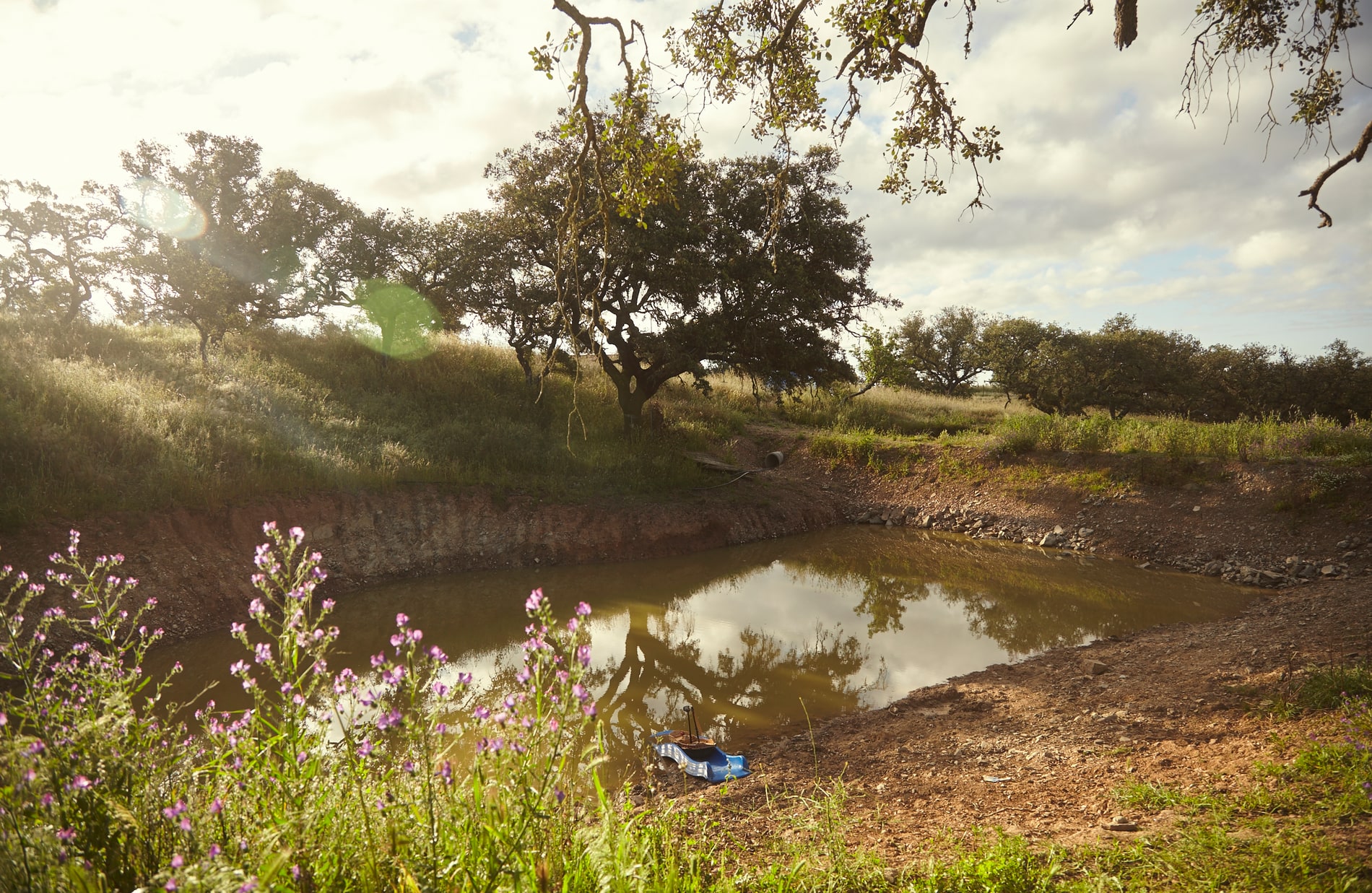
Equally critical is water landscape restoration – regenerating the hydrological cycle that we disrupted. Techniques often fall under what permaculturist Sepp Holzer calls "Water Retention Landscapes"[23][24]. The principle is straightforward: instead of draining water off the land as fast as possible (as conventional infrastructure does), we slow it, spread it, and sink it into the earth. Practically, this involves earthworks like swales on contour (shallow ditches that capture runoff), small check dams in gullies, and restoration of wetlands or ponds. It can also mean re-contouring eroded slopes, planting deep-rooted vegetation, and mulching bare soil – all to enable the ground to hold rain like a sponge. In healthy ecosystems, rainwater is absorbed and released slowly through springs and stream baseflow, keeping rivers perennial and vegetation green through dry seasons[25][26]. We aim to recreate these conditions. Our projects are required to "capture and store rainfall through swales, ponds, terraces, and other earthworks; design landscapes to slow, spread, and sink water."[27] Already at TDF, a series of small ponds and soil bunds have been dug so that winter rains replenish the groundwater instead of causing floods. The result is visible in newly sprouting willows and reeds around the pond edges – signs that water is staying where it falls, giving life rather than rushing away. These measures also mitigate climate extremes: by holding more moisture, the land becomes cooler and moister (reducing heatwaves and fire risk) and provides reserves for times of drought.
Finally, regeneration must include reviving native species and removing invasive ones that hamper ecosystem function. Rewilding is not just letting nature be; sometimes it needs a helping hand to recover from past abuses. This can mean reintroducing keystone species (like beavers to a watershed to restore wetland dynamics) or simply planting indigenous trees and wildflowers in areas where the seed bank is depleted. OASA's biodiversity principle emphasizes planting native species and actively supporting native flora/fauna while controlling invasives[20][28]. For instance, in Portugal we remove invasive eucalyptus saplings (a legacy of monoculture plantations) to give space for oak and cork trees to regenerate. In parallel, we see ourselves as citizen scientists of regeneration, documenting how the return of each plant or animal contributes to the greater tapestry. A small example: as native cork oaks recover, we notice more mushrooms (which need the symbiosis with oak roots), and those fungi in turn improve soil structure and nutrient cycling for other plants. Every element is connected.
In summary, the regenerative approach flips the script on land use. Where the old model sought maximum immediate extraction, the new model seeks maximal ecological function. By rewilding large areas, implementing agroforestry and regenerative farming on working lands, redesigning water management, and fostering biodiversity, we set in motion healing processes that compound over time. We also rekindle a cultural relationship to land as something sacred and communal. People often ask: How will we feed the world this way? The truth is, we cannot feed the world in the long run with the current system – it is undermining its own resource base. Regenerative systems, by contrast, create the fertility and stability on which future food security depends. They may produce slightly less commodity grain per hectare in the short run, but they produce far more total nutrition per hectare when polyculture outputs are counted, and they do so without eroding the soil or drying the rivers. Over a 300-year horizon – which is the timescale we must consider – regenerative land stewardship is the only viable path. We are not romantic naifs; we are pragmatic ecologists guided by both ancestral wisdom and cutting-edge environmental science.
Monitoring and Technology for Stewardship in the 21st Century
An irony of our age is that while technology was often wielded to conquer nature, it can also be repurposed to heal and understand nature. A key aspect of OASA's model is integrating modern monitoring systems to support our ecological goals. We recognize that you cannot manage what you do not measure – and that transparent, trustworthy data can empower communities to remain accountable to their promises of regeneration. In practical terms, each OASA land project deploys a suite of tools: environmental sensors, satellite imaging, drones, and lab analyses – all complemented by the keen eyes of local stewards on the ground. According to our charter, "Each project deploys sensors, drones, satellites, lab monitoring and community observations to track water infiltration, soil moisture, biomass, biodiversity, carbon capture etc."[29]. These data feed into open dashboards accessible to all members (and to independent guardians), creating a living "digital twin" of the land that can be observed and learned from.
One exciting technology we employ is Environmental DNA (eDNA) analysis for biodiversity monitoring. Every organism in an ecosystem leaves traces of its DNA in the environment (through shed skin, scales, pollen, feces, etc.). By sampling soil or water and sequencing the genetic material found, we can discover which species are present – including elusive or nocturnal creatures that traditional surveys might miss. This method is revolutionizing how we track wildlife and ecosystem health. As the Swiss startup SimplexDNA (one of our partners) explains, "Using Environmental DNA analysis we can identify organisms that are present at a given place and time without direct observation... The resulting data makes biodiversity visible. From microbes to mammals."[30]. Imagine dipping a bottle into a stream and, through eDNA, detecting not only the fish in that stream but also the frogs, insects, and even upstream mammals that came to drink – all from a few liters of water. We use eDNA to establish baseline inventories of life on our lands and to monitor changes year by year. The goal is to see, for instance, if our rewilding efforts are bringing back more amphibians, or if our farming practices are allowing native pollinators to flourish. This technology brings scientific rigor to what might otherwise be anecdotal evidence of "doing good." It also engages our community in the wonder of discovery; collecting eDNA samples has become a beloved activity during volunteer weekends, like a treasure hunt for signs of life.
Complementing eDNA, we have deployed networks of soil and water sensors. These range from simple devices like soil moisture probes (which tell us how well our water retention strategies are working) to more advanced multi-parameter stations that measure temperature, humidity, and even soil nutrient levels. We monitor groundwater wells to track aquifer recharge, and small weather stations to correlate our interventions (like reforestation) with microclimate changes. Satellite data provides the macro view: we use open-source satellite imagery to observe vegetation cover and growth over seasons. The Open Forest Protocol (OFP) in particular provides a platform for leveraging such data to verify forest restoration progress. The OFP is "a digital platform being developed as a measurement, reporting, and verifying (MRV) tool for forestation projects, with the aim of improving transparency in forest projects and enabling access to carbon financing."[31] We contribute our tree growth data to this decentralized system, effectively putting our forest on the blockchain for anyone to audit. Through OFP and similar platforms, a restored forest's carbon sequestration (and other ecosystem services) can be quantified and potentially turned into carbon credits or biodiversity credits – not for speculative profit, but as additional funding streams for conservation. (We are cautious with carbon markets, aware of their pitfalls, but we also recognize that if done right, they can channel resources to regenerative projects. Transparency and rigorous MRV are the key, hence our involvement with OFP).
All these monitoring efforts serve a deeper purpose: keeping stewardship governance honest and adaptive. In OASA, we have established a role for Guardians of Nature – individuals or councils that represent the rights of water, soil, air, and other more-than-human elements in our governance structure[32][33]. These Guardians (some human, potentially some AI-assisted as our charter allows[34]) review the data coming in and have the power to flag or veto decisions that violate ecological principles. For example, if a project's annual report shows declining soil health or bird counts, a proposed expansion of agriculture into a wild area might be halted for review[35][36]. The data itself is made public as much as possible – an expression of the "digitized commons" philosophy that information about the commons should itself be held in common[37][38]. This radical transparency distinguishes our approach from old top-down conservation models. Locals and remote supporters alike can see a project's pulse: how much solar energy it's generating, how much water stored, how many species observed this quarter. In a way, we are crowdsourcing the watchdog function: anyone can hold us accountable if the numbers start to slip. And conversely, anyone can celebrate with us when the data shows a success – say, an increase in soil carbon or the return of a lost species.
It is important to emphasize that technology is a tool, not a silver bullet. We are careful to pair hi-tech solutions with low-tech, nature-based solutions. A sensor might tell us the soil is dry, but planting a swale and mulching will actually fix it. Drones can map tree survival rates, but hands with shovels plant the trees. We avoid techno-utopianism; indeed, one might say our approach is techno-pragmatism in service of eco-utopianism. By reconciling technology with ecology, we hope to embody a reconciliation between Western scientific approaches and traditional ecological knowledge. There is beauty in this marriage: the precision of sensors meeting the wisdom of elders, the satellite view aligning with the farmer's almanac. We often host hackathons on-site where engineers camp under the stars and code sensor firmware by the campfire – a blending of two worlds that historically were at odds. As one commentator wrote, "Humanity's path to progress must emphasise long-term resilience, accepting complexity and placing cooperation over rivalry. By aligning innovation with nature's principles, we can cultivate a future where we thrive not in spite of nature, but because of it."[1]
Living Models of the Commons: Proof of Concept from Parks and Trusts
Skeptics may wonder whether commons-based stewardship can truly work in practice, given human tendencies toward short-term thinking or free-riding. In answer, we can point to numerous successful long-term commons and land trust models that inspire and inform us. These are projects that have, in effect, de-commodified land and managed it as a trust for public benefit, with impressive results.
One shining example sits in the heart of New York City: Central Park. Often taken for granted as a public good, Central Park in the 1970s had fallen into disrepair due to underfunding and tragedy-of-the-commons dynamics (everyone used it; no one adequately cared for it). The creation of the Central Park Conservancy in 1980 turned that around. This private nonprofit operates as a kind of commons trustee for the park. It raises funds, engages volunteers, and makes decisions in partnership with the city. Over forty-plus years, the Conservancy has raised and invested over $1 billion into restoring and enhancing Central Park[39]. Today the Conservancy covers the majority of the park's annual operating budget (roughly $74 million per year) through donations and endowment[39]. The payoff is visible in every tree and restored wetland – the park is a vibrant oasis of biodiversity and a beloved commons for millions of people. The Conservancy model shows how a trust structure and community governance can succeed where fragmented city management failed. By all accounts, every dollar spent on the park has returned many more in ecosystem services, tourism, and public health benefits. Perhaps most importantly, it has protected Central Park from the fate of so many urban spaces that could have been privatised or commercialized; instead, it remains in trust, for public use, in perpetuity. The Conservancy is effectively a perpetual steward (with strong accountability to its many donors and park users). We take inspiration from this. OASA's legal structure – a Swiss association with a mandate to hold land for regenerative projects – aspires to be akin to a global conservancy for many "central parks" of the future, not just urban parks but rural commons and eco-villages that need custodial protection and professional management.
Another powerful model is the Trust for Public Land (TPL) in the United States. TPL has, since the 1970s, pioneered the idea of proactively buying land to save it from development, then either turning it into parks or transferring it to local communities and agencies for long-term stewardship. The scale of their impact is remarkable: "Since 1972, [TPL has] helped protect 4 million acres of land and generated $111 billion in public funding" for conservation projects[40]. This leveraged approach – using some philanthropic dollars to unlock larger public financing – has resulted in thousands of new parks, greenways, and natural areas across the country, including in cities where park access was lacking. TPL's work includes not just wild landscapes but also cultural sites and urban community gardens. What we learn from TPL is the importance of institutional innovation: they showed that a nonprofit can operate in the market (buying land) to outcompete private developers, essentially using the tools of capitalism to achieve anti-capitalist ends (land kept in the commons). They also emphasize community involvement, ensuring that once land is saved, it reflects local needs and ongoing care. An example is how TPL helped communities in California's East Bay create the "Emerald Necklace" of interconnected greenbelts, or how they are partnering with Tribal nations to reclaim ancestral lands taken in the past[41]. These successes stand as proof that with the right mechanisms and public support, land can be decommodified and managed for the common good across generations.
Outside the U.S., there are analogous models: the National Trust in the UK protects historic and natural sites through a membership-supported charity; community forests in Nepal managed by local user groups have improved forest cover while benefiting villagers; the ejido commons in Mexico, though challenged, still manage large areas of farmland and forest collectively. Even the UNESCO World Heritage Sites program can be seen as a kind of global commons trust for areas of "Outstanding Universal Value." Each offers lessons – from governance structures that promote accountability, to financial models that sustain the work (endowments, volunteer labor, government grants, etc.), to legal frameworks that lock in protections (conservation easements, covenants, etc.). We study these precedents at OASA, learning what has worked and where pitfalls lie. One recurring theme is that plural stakeholders must be involved: government alone or community alone often is not as effective as a partnership that brings together public authority, community passion, and private/philanthropic resources. That triangulation yields resilience.
The commons is sometimes caricatured as either utopian or tragic. But these living models demonstrate a middle path: institutions that are neither top-down state control nor free-for-all privatization, but something in-between – collaborative, evolving, rooted in both values and evidence. Our aim is to contribute a new chapter to this story: commons 2.0, augmented by tech, financed by ethical investment, and scaled to address global challenges like climate change. When someone asks, "How do you know a regenerative village held in common will last? Won't it fall apart or be bought out?" – we can point to Central Park, still green after 40 years of Conservancy care, and say we intend to be at least as durable. We write into our Constitutions that lands under OASA cannot be sold or used as collateral; they exit the speculative market forever. They become, in essence, Zones of Hope, held by trust structures designed to last beyond any of our lifetimes. We align incentives such that the value that is generated (beauty, biodiversity, livability) flows back into maintaining and spreading that value, not into private profit. This is how you break the cycle of boom and bust and ensure intergenerational equity – by design.
Humans as Keystone Species: Reconciliation with Nature
Underlying all these efforts is a philosophical and spiritual shift: a reconciliation between the dominant culture of the "West" (and its technological worldview) and the rest of Nature. For centuries, the West's narrative was one of human supremacy over nature – a hierarchy with Man on top, conquering the wild. That narrative is crumbling under the weight of ecological reality. In its place, we see a resurgence of an older understanding, long held by Indigenous peoples and echoed now by ecologists: Humans are not separate from nature; we are part of it, and indeed we can play a unique and positive role. In ecological terms, humans are a keystone species[19]. This is a liberating realization. It means that our involvement in ecosystems is not inherently negative or guilty – it can be profoundly generative. As one ethnobotanist eloquently put it, forager-horticulturalist societies "increased both biodiversity and the total biomass produced by land" through their interventions[42][7]. They were consciously enhancing the land's capacity, not just taking from it. This flips the script on what "development" means. Real development could mean enriching life (in both the biological and human sense) rather than just accumulating material wealth.
So what does it look like for modern, technology-equipped humans to become keystone species in a good way? It looks like reintroducing missing species (from beavers to bees) and tending their habitat. It looks like mimicking natural disturbances – e.g. controlled burns to prevent catastrophic fires and renew forests, akin to the "fire stick farming" of Indigenous Australians[8]. It looks like optimal foraging strategies that actually stimulate more growth: studies have shown, for example, that moderate harvesting of certain wild plants can increase their abundance by spreading seeds and reducing competition[43][44]. In our context, it looks like a community treating its landscape as a garden at ecosystem scale – not a garden of neat rows, but a wilder garden where humans catalyze successional processes, then step back. We sometimes describe the role of future inhabitants of OASA villages as akin to forest gardeners or ecological rangers. Their job is to observe and respond: if a pond is silting up, they might carve a new overflow channel and use the silt to create a wetland; if an area is lacking pollinators, they might rear native bumblebee colonies and release them; if a rare orchid appears, they'll mark the spot and make sure it's not trampled. Far from being idle in nature, they are deeply participatory, but always with the aim of tipping the balance toward more diversity, more resilience.
Crucially, this also entails a humbling of our species. To live in harmony, we must re-learn Respect, Reciprocity, and Relationship (the "Three Rs" often cited in Traditional Ecological Knowledge)[45][19]. Respect means recognizing other beings and elements – trees, rivers, mountains – as having their own integrity and worth, not merely as resources. Reciprocity means giving back to the land, not just taking: for instance, if you harvest timber, you plant and tend new trees; if you divert water, you ensure the source is recharged. Relationship means long-term commitment – seeing ourselves not as conquerors but as kin to the more-than-human world. At OASA gatherings, it's not unusual that our decision-making circles begin with a moment of gratitude to the local land spirits or an acknowledgment of the original Indigenous custodians of the territory. We incorporate practices like agroforestry and permaculture not only because they are effective, but because they cultivate a mindset of working with natural processes, not against them. The reconciliation we seek is as much internal (a shift in consciousness) as external (new policies or projects).
This reconciliation also invites Western science and Indigenous knowledge to dialog. We've had the honor of collaborating with local elders and knowledge-keepers when shaping our land plans. One elder from a First Nations community in Canada, who visited as part of a cultural exchange, told us: "The sooner we figure out what the land needs, the sooner we relieve our eco-anxiety, because we'll know what to do – and we'll know that Mother Earth can recover."[46][47] There is profound hope in that statement. Yes, there is fear and grief for what is being lost, but there is also empowerment in realizing that we can help Earth heal, and that she wants to heal. We just have to give her the chance, and be willing to participate humbly in the process.
In many ways, what we are attempting is to bridge the best of both worlds: the wisdom of ancient stewardship with the capabilities of modern society. Western civilization's strengths – technology, global coordination, scientific method – must be bent toward serving the Community of Life rather than subjugating it. Think of it as a grand reconciliation or even a marriage: Science brings detailed understanding; Tradition brings ethical framing and long-term memory. Together, they can midwife a new-old way of being human on Earth. This is the deeper significance of becoming keystone species again. It means we re-assume our responsible role in the web of life – a role that indigenous cultures never abandoned, but that industrial culture largely forgot. If we succeed, future generations might look back at this century not only as a time of crisis, but as the beginning of a Great Reconciliation – when humans came home to the Earth.
OASA: A Working Protocol for the Regenerative Future
All these ideas converge in OASA's work. OASA (which stands for the Open Autonomic Settlement Association) is our attempt to build an operating system for a regenerative civilization – one village, one forest, one watershed at a time. It is not a theoretical framework; it is a functioning organization and network of projects, born from the very urgent need to transition actual pieces of land from extractive ownership to commons-based stewardship. I often describe OASA as a bridge between two worlds: the world of impact investors, blockchain and legal hacks on one side, and the world of permaculture, land trusts and bioregionalism on the other. We use novel tools (like tokens and DAOs) but we ground them in age-old principles of ecology and community.
At its core, OASA is a land trust that acquires or receives land (through purchase, lease, or donation) and places it into a protected commons for regenerative projects. Unlike traditional land trusts that might focus on wilderness conservation, OASA's focus is on human-inhabited regenerative settlements – what some call "ecovillages" or "regenerative villages." The twist is that we use blockchain-based tokens to represent membership and usage rights in these projects, which allows us to raise capital in a innovative way and manage access/governance transparently. Importantly, these tokens are non-speculative by design. The OASA constitution explicitly forbids treating them as profit-seeking instruments: "Tokens provide usage rights (nights, harvest shares, votes) and do not promise financial returns… They are not redeemable for currency."[48]. We further ensure this by using a bonding curve issuance model, where the token price increases algorithmically as more tokens are issued (reflecting the project's carrying capacity) and tokens cannot be sold back to the issuer[49]. This means early buyers can't just flip tokens for profit; the only way to exit is to sell to someone who wants to use the project (once a certain phase is reached) – thus the token's value is always tied to its use-value (e.g. the right to stay in the village or partake in its yields) rather than some speculative frenzy[50]. In short, we have engineered the system so that it's attractive to stakeholder-investors (people who care about the project and want to use it) but not attractive to speculators looking for quick gains.
The Traditional Dream Factory ($TDF) token is our first real-world demonstration of this model. 1 $TDF token is pegged to 1 night's stay per year forever in the TDF village, for one person[51]. Token holders become "citizens" of the village, with governance rights and the ability to book stays in various accommodations (from camping spots to future eco-homes). The initial token sale – done via a bonding curve – provided the capital to purchase the land and start infrastructure building[52]. In essence, early supporters paid upfront for nights they will enjoy over many years, and their money was used to finance the regenerative development. This is a transition finance mechanism: the land and project are funded not by extracting resources (e.g. cutting timber to sell) nor by taking out traditional loans (which would require repayments with interest), but by preselling future regenerative use of the place. It's akin to a community-supported agriculture model, but for living and housing rights. As the village gets built and reaches its capacity (in TDF's case, ~75 residents/guests at a time, equating to 18,600 token-nights per year[53]), the token supply will be fully distributed. At that point – the "Go-Live" moment – tokens become transferable between individuals[54]. This allows newcomers who want to join in later to purchase tokens from earlier holders. Early backers who perhaps can no longer participate can exit by selling their tokens (at a value likely higher than they bought, reflecting the matured project's value, but again, that value is capped by the use rights). In this way, early risk-takers are repaid by future inhabitants, but in a controlled, mission-aligned way that doesn't compromise the community or invite speculators. All the while, the land remains in OASA's non-profit trust ownership, protected by legal covenants against sale or unsustainable use.
To date, TDF has over 280 token holders sharing a 25-hectare site[55], and the model has proven viable: we raised over €1 million which has financed reforestation, water systems, and the construction of communal infrastructure. These token holders are not absentee investors; they are actively engaged. Many have come to the land to plant trees, build soil, and celebrate at our annual gatherings. They have a collective governance process (facilitated through a DAO) to decide on budgets, elect local stewards, and approve any major changes. But here's the beauty: because the Guardians of Nature (mentioned earlier) hold veto power on ecological matters[32][36], even the token-holders' assembly cannot override the regenerative Principles. In combination, this ensures that financial contributors cannot skew decisions toward profit at the expense of ecology – a common failure mode in co-ops or HOA's. We've essentially separated use rights from governance rights: you gain governance by actually spending time on the land and contributing ("proof of presence"), not by simply holding more tokens[56]. This prevents wealthy individuals from buying up tokens to dominate votes – another guardrail against speculation.
Aside from tokens, OASA welcomes philanthropic and impact investment as what we call Catalytic Capital. As stated in our charter, "OASA encourages philanthropic and impact investors to provide early-stage funding for land acquisition and regeneration… This capital is non-speculative; returns are measured in ecological health, community resilience, and the long-term stability of use-value tokens."[57]. In practical terms, this might mean an impact fund gives a 0% interest loan or a recoverable grant to buy a piece of land, with the understanding that as the project issues tokens, part of that revenue will pay back the fund. But again, the payback is tied to actual people joining and using the land (not rent extraction). We are exploring a mechanism called a Transition Dividend: early capital that enabled the project can be gradually reimbursed from operational surpluses once the community is up and running. This is similar to how community land trusts sometimes operate – early donors can be repaid if/when the project achieves financial sustainability, but without any compounding interest. The whole idea is to front-load the generosity (from impact investors) and allow the community to buy its own freedom over time. At scale, as more regenerative villages replicate, one could imagine a cycle of generosity: today's beneficiaries become tomorrow's benefactors for new projects, passing forward the gift.
Throughout this design, ecological principles remain the North Star. OASA's constitution is effectively an agreement that any project in the network must pursue regenerative outcomes – soil building, water conservation, habitat restoration, etc. – as a condition of participation[58][59]. If a project fails to uphold these, the governance structure has means to correct or ultimately remove that project[60]. In essence, we've coded into our legal and digital DNA that Earth comes first. The humans benefit immensely – through healthier food, beautiful surroundings, meaningful work, and vibrant communities – but not by consuming the Earth, rather by co-flourishing with her. This reframes what "development" means on our lands: success is measured in increasing bird songs, cleaner water, happier people, and knowledge shared openly to the world. Indeed, one of our Principles is that each project must "share knowledge and creations openly… contribute to the broader commons by publishing plans, code, and lessons learned"[61]. We firmly believe regenerative development should not result in proprietary secrets or gated technologies; it should enrich the global commons of ideas and practices. In that sense, OASA is as much an open-source movement as it is a land management entity.
OASA is still young – a work in progress – but it is working. It is not a speculative whitepaper or a future promise. Land is being healed now. Communities are gathering now. Our Transition Token mechanism enabled Traditional Dream Factory to leap from vision to reality in a short time, without waiting for slow grants or bending to venture capital demands. The trees we planted are growing; the soil is slowly coming alive with earthworms; children (yes, we have babies on the land now) will grow up with an intimate connection to their forest-garden home. And critically, none of this can be yanked away by a corporation or a landlord in the future – the commons is secured structurally. This gives all involved a great sense of confidence and responsibility. We often say, borrowing from a proverb: we do not inherit the land from our parents; we borrow it from our children. In OASA's constitution we went a step further, mandating that all decisions be evaluated for their impact on seven future generations[62]. It's literally written that no action may compromise the ability of future communities, human or more-than-human, to thrive. This ethos permeates everything – from how we design a building (will it last 100 years and use local materials?) to how we design the token economy (will it remain fair for those not yet born?).
Returning Home to the Commons
We stand at a crossroads of history – a point where we must choose between continuing down a path of commodification that is clearly failing, or embarking on the hard but beautiful journey of regeneration and reconciliation. The transition from extractive land ownership to regenerative commons-based stewardship is not only possible; it is already underway. It is in the restoration of a wetland by villagers in India, in the community garden in Detroit reclaiming abandoned lots, in the reintroduction of bison to ancestral lands on the Great Plains, and in projects like ours at OASA knitting these efforts into a shared framework. Each of these is a piece of a larger puzzle: a vision of human society reintegrated with the cycles of Gaia.
This manifesto is both a declaration and an invitation. It declares that we refuse to accept the doom of ecological collapse as inevitable – we know that by changing our systems and our values, we can bend the curve of decline. It invites all who read it to consider your own role in this great turning. Whether you are a technologist, a farmer, a policymaker, an artist, a young student or a retired grandparent, you have something to contribute. Perhaps you will join an existing commons initiative, or start a community land trust in your town. Perhaps you will simply choose to garden with native plants and help restore a bit of wild on your doorstep. Or perhaps you will come visit us at Traditional Dream Factory or a future OASA village – and plant a tree, share a meal, lend your skill, become a commoner of the new era.
We do not imagine that this transition is easy. But it is essential. And once you begin living it, a remarkable thing happens: despair recedes, replaced by hope. The work of healing land heals ourselves. In the commons, supported by community and connected to nature's rhythms, people find purpose and joy that no amount of consumptive entertainment can match. I have experienced this personally – the most fulfilling moments of my life have been knee-deep in mud, repairing a pond berm after a storm with neighbors singing beside me, and later seeing that pond brim with life. In those moments, I know: this is how it's meant to be. Humans as humble participants in the grand symphony of the living Earth, adding our voice, not drowning out others.
I call on you to co-create this reality with us. If you have land and want to protect it, consider placing it into a new commons. If you have resources, consider investing them not in the old extractive stocks, but in regenerative enterprises and land trusts. If you have time, volunteer in restoration – become a Guardian of your own local patch of Earth. We welcome collaboration, critique, and new ideas. The work ahead is intergenerational, but it needs pioneers now to set it in motion.
In closing, picture this: a network of thriving commons spreading across the globe like green shoots – each one a sanctuary of biodiversity, a cradle of a small cooperative community, and a node in a larger commons that shares knowledge and solidarity. Picture the dusty brown lands turning green, the rivers running clear, the songs of frogs at night and the laughter of children in food forests. This is not a utopia beyond reach. It is simply the continuation of the story of life, with us playing our rightful role once more. It is, in truth, a return home – home to the commons that have always sustained us.
Let us transition, together, from the age of commodities back to the age of commons.
Samuel Delesque
Footnotes (References)
[1] [64] On the Path to Reconcile Ecology and Technology
https://revolve.media/opinions/on-the-path-to-reconcile-ecology-and-technology
[2] [3] [4] [5] [6] [18] [63] The Enclosure of the Commons
https://twn.my/title/com-cn.htm
[7] [8] [42] [43] [44] Humans are a Keystone Species
https://www.worldwild.org.uk/blog/humans-are-a-keystone-species
[9] [10] State of nature report finds 1 million species threatened with extinction
https://www.axios.com/2019/05/06/earth-faces-accelerating-extinction-crisis-global-report
[11] [12] Biotic pump - Wikipedia
https://en.wikipedia.org/wiki/Biotic_pump
[13] [14] [15] Amazon tree loss may worsen both floods and droughts: study
https://phys.org/news/2025-03-amazon-tree-loss-worsen-droughts.html
[16] Deforestation can cause eight-fold increase in flood event risk, says report
https://www.unsw.edu.au/newsroom/news/2025/10/Deforestation-eight-fold-increase-flood-event-risk
[17] [23] [24] [25] [26] Water Retention Landscape – a holistic and regenerative approach
https://www.tamera.org/water-retention-landscape/
[19] [45] [46] [47] Traditional Ecological Knowledge, kids & eco-anxiety l C&NN
https://www.childrenandnature.org/resources/fnn-how-lessons-from-traditional-ecological-knowledge-can-support-kids-and-stave-off-climate-anxiety/
[20] [21] [27] [28] [29] [32] [33] [34] [35] [36] [37] [38] [48] [49] [50] [55] [57] [58] [59] [60] [61] [62] OASA – Building the Operating System for a Regenerative Civilization
https://oasa.earth/
[22] [53] [56] [65] [66] Launching the $TDF token sale
https://www.linkedin.com/pulse/launching-tdf-token-sale-charlie-fisher
[30] SimplexDNA AG - Winterthur-based biodiversity detection with DNA-based methods
https://www.simplexdna.com/
[31] Open Forest Protocol — Smart Forests Atlas
http://atlas.smartforests.net/en/logbooks/open-forest-protocol/
[39] Governance | Central Park Conservancy
https://www.centralparknyc.org/governance
[40] [41] Protecting Public Lands: Trust for Public Land
https://www.tpl.org/our-mission/lands
[51] [52] [54] $TDF Token - Traditional Dream Factory
https://www.traditionaldreamfactory.com/token